Shrinath Bhat
Anheuser-Busch InBev, Hector Beverages
Undergraduate Institution
IIT Madras
Pre-MBA Career
Anheuser-Busch InBev, Hector Beverages

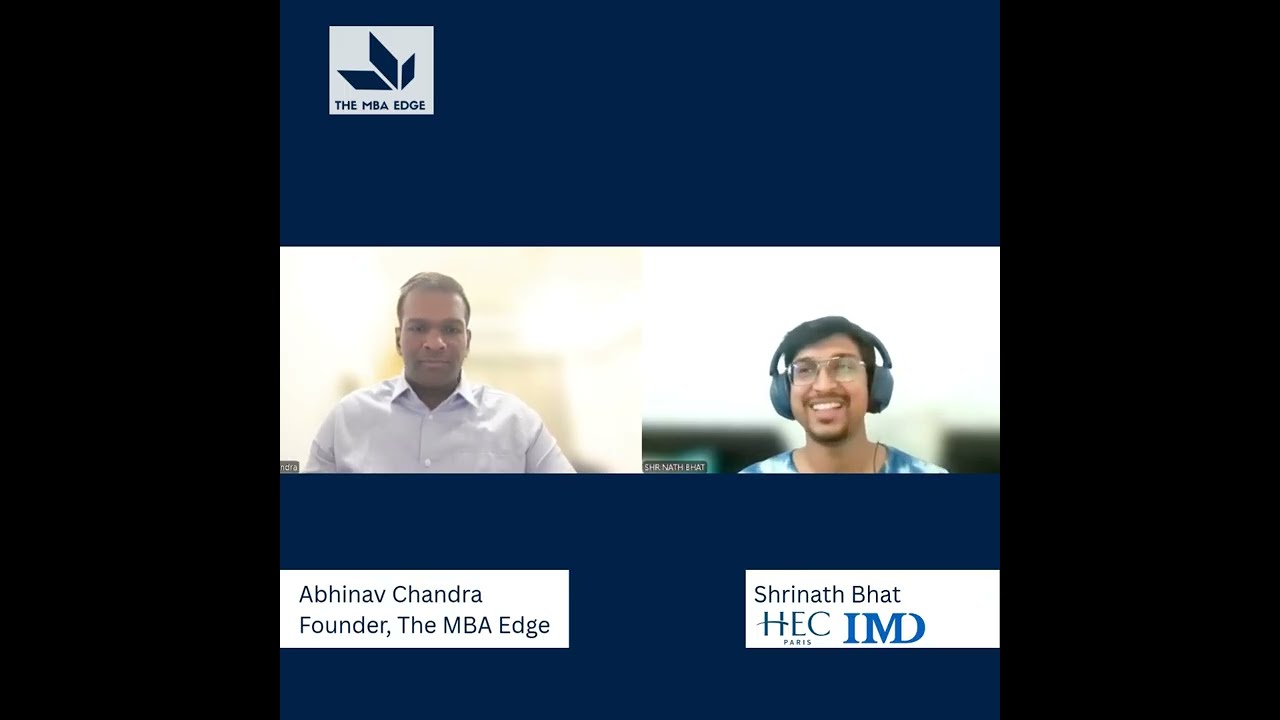
From IIT Madras to HEC Paris: Shrinath’s Journey to a Global MBA
Shrinath, you have a pretty unique background-from IIT Madras to one of India’s largest FMCG companies, followed by an stint with a fast-scaling beverage brand. Tell us a little about your journey.
Sure. I come from a very small village in North Karnataka, and my father works at a nuclear power plant. Growing up, I was fascinated by technology, which eventually led me to pursue Mechanical Engineering at IIT Madras.
While I was at IIT, I was trying to figure out what I really wanted to do with my career. That's when I discovered data science, which became something I was genuinely passionate about.
After IIT, I went on to work with a large FMCG company and eventually took an entrepreneurial route, working with one of India's fast-scaling beverage brands.
So, while my journey has taken me through technology, FMCG and entrepreneurship, I've always been interested in understanding how businesses work and how I can grow into larger leadership roles.
Why an MBA After Engineering and FMCG?
There is a common perception that if you're already on an entrepreneurial path, you don't necessarily need an MBA. What made you consider an MBA at this stage of your career?
That's actually a question I asked myself for a long time as well.
I feel I've reached a point where I'm fairly strong in functional execution and have a good understanding of how a business works within my area. But I felt there was still a gap in understanding the business as a complete system.
That's where I felt an MBA could add a lot of value.
I wanted to develop a more holistic understanding of how different parts of a business come together—strategy, finance, marketing, operations and leadership. In the long term, I believe those skills will help me move into transformation and leadership roles.
There was definitely a small part of me that wondered whether I should simply stay back and continue growing within the company. But ultimately, I felt that taking this step would help me accelerate my career and broaden the kind of roles I could take on in the future.
Why a Global MBA?
Shrinath: There was another important consideration for me.
I had already completed my Bachelor's from IIT Madras, so I was thinking about what was still missing from my education.
The biggest gap I identified was global exposure
I didn't just want to understand how businesses work in India. I wanted to understand how businesses operate across different markets, cultures and geographies.
For me, an international MBA offered that perspective. I felt that being in a global classroom, learning alongside people from different countries and backgrounds, would help me become a much better decision-maker and prepare me for a more global career.
Planning the MBA Journey
How did you actually go about planning your MBA decision and application process?
Shrinath: I started with a lot of research.
I already had some exposure to the global MBA journey because many of my classmates and colleagues had pursued MBAs abroad. So I started by speaking with them and understanding their experiences.
The next step was preparing for the GMAT. Given my quantitative background, GMAT felt like a better fit for me than the GRE. I prepared for around six months alongside my full-time job. It took a lot of consistency, but eventually I reached a score I was happy with—750 equivalent, or 705 on the GMAT Focus Edition.
At the same time, I was researching business schools and understanding which programs would be the right fit for me.
I was a little late in the application cycle, so I applied in Round 2. That made the process quite hectic because I was simultaneously managing a full-time job, researching schools, reaching out to people on LinkedIn and working on multiple applications.
Having guidance through that process helped bring a lot more structure and clarity to both my thinking and my applications.
Why Europe?
You were quite focused on European business schools from the beginning. What made Europe the right choice for you?
Shrinath: I don't think there's one right answer when it comes to choosing between India, Europe or the US. It really depends on what you're looking for.
For me, it came back to the gap I had identified in my education: global exposure.
European MBA programs offer an incredibly diverse classroom, with people from different countries, cultures and professional backgrounds. That was something I really valued.
I also think about decisions almost like an optimization problem, which probably comes from my data science background.
I have an objective—what kind of life and career do I want? For me, that includes good quality of work, a good quality of life and a healthy work-life balance.
Then there are constraints: my background, my financial situation, my existing experience and what I want to achieve professionally.
When I looked at all those factors together, Europe emerged as a very strong fit.
I've also always been fascinated by Europe and could see myself spending more time there in the long term. So an MBA there could solve two problems at once: give me the global perspective I was missing and provide me with the broader business toolkit I wanted to develop.
What Surprised You During the Application Process?
The application process can be quite a roller-coaster. Was there anything that particularly surprised you?
Shrinath: The biggest surprise was actually how supportive the MBA community was.
Initially, I wondered why someone who didn't know me would spend 30 minutes or an hour speaking with me about their MBA experience. Everyone is busy—they're studying, working, looking for jobs or managing their own lives.
But almost everyone I reached out to was incredibly generous with their time. People shared their experiences, the pros and cons of different programs, what they would do differently and what I should watch out for.
That was something I really didn't expect.
I realized that the MBA community genuinely wants people to grow with them. Even after you get into a school, you can continue reaching out to alumni and other members of the community for career advice, job opportunities or simply perspective.
That was one of the most encouraging parts of the entire process.
Choosing HEC Paris
And after all the research and applications, where are you finally headed?
Shrinath: I'm heading to HEC Paris.
I was fortunate to apply to several top European business schools and receive admits from a few of them. But after carefully considering the options, HEC Paris stood out for me.
The combination of the quality of education, the diversity of the cohort and the post-MBA opportunities made it a very strong fit.
Most importantly, it offers the experiential learning and global perspective that I was looking for from the beginning.
So I'm really excited to be joining HEC Paris in January 2027.
Advice for Future MBA Applicants
If you could go back nine months to when you were just starting this journey, what advice would you give someone who is currently thinking about an MBA?
Shrinath: I'd probably break it down into a few things.
1. Start Early—But Don't Wait to Start
The first thing I'd say is: start researching immediately.
Don't wait until you think you're completely ready.
Understand whether you want to pursue an MBA in India or abroad, which exams you'll need to take, and what the overall application timeline looks like.
If you're applying abroad, understand whether GMAT or GRE is the better fit for you. If you're looking at Indian schools, understand whether CAT, GMAT or another exam is required.
The important thing is to start the process and understand what you're getting into.
2. Treat Test Preparation Like a Marathon
Once you've chosen your exam, spend the first few weeks understanding the exam structure, question types and scoring methodology.
Then create a structured study plan and stick to it.
Preparing for the GMAT isn't really a test of intelligence. It's about consistency and understanding your own mistakes.
For me, maintaining an error log was incredibly useful. I tracked the kinds of mistakes I was repeatedly making and focused on eliminating those patterns.
I also took multiple mocks and analyzed them carefully. Just before my GMAT, I took around 15 mocks over a couple of months.
The biggest improvement came from fixing recurring mistakes rather than simply doing more questions.
3. Understand Your Career Story
For the MBA application itself, I'd strongly recommend getting guidance if you're new to the process.
But even before that, you need to understand three things:
Where are you today?
Where do you want to go?
What's the gap between the two?
Then ask yourself: How will an MBA help me bridge that gap?
I think of it almost as a triangle. Your current position, your future goals and the role of the MBA in connecting the two.
Once you're clear on that, your application story becomes much easier to build.
And it needs to be genuine.
Your application shouldn't sound like you're simply listing achievements or writing what you think an admissions committee wants to hear. It needs to reflect your actual journey—your strengths, your gaps, your experiences and what you've learned along the way.
Don't Compare Your Journey With Someone Else's
Shrinath: And there's one final piece of advice that I think is extremely important: don't compare your journey with someone else's.
Everyone has a different background.
Even if two people went to the same college, they may have had completely different experiences, opportunities, financial circumstances, exposure and career paths.
So there isn't one standard set of schools that everyone should apply to.
Different business schools have different cultures, communities and strengths. What works for one person may not work for another.
The most important thing is to understand your own journey and find the schools that fit your goals.
Looking Ahead
Shrinath, it's been great speaking with you. Congratulations once again on HEC Paris, and we wish you all the very best for the journey ahead.
Thank you so much. It's been a great experience, and I'm really looking forward to what's ahead.
If you are planning to apply to MBA programs this upcoming application season, reach out to our team at info@thembaedge.com to explore synergies to collaborate together.
Follow The MBA Edge where we regularly post information on MBA applications and careers.