Nehaal Rao
Sustainability Marketing
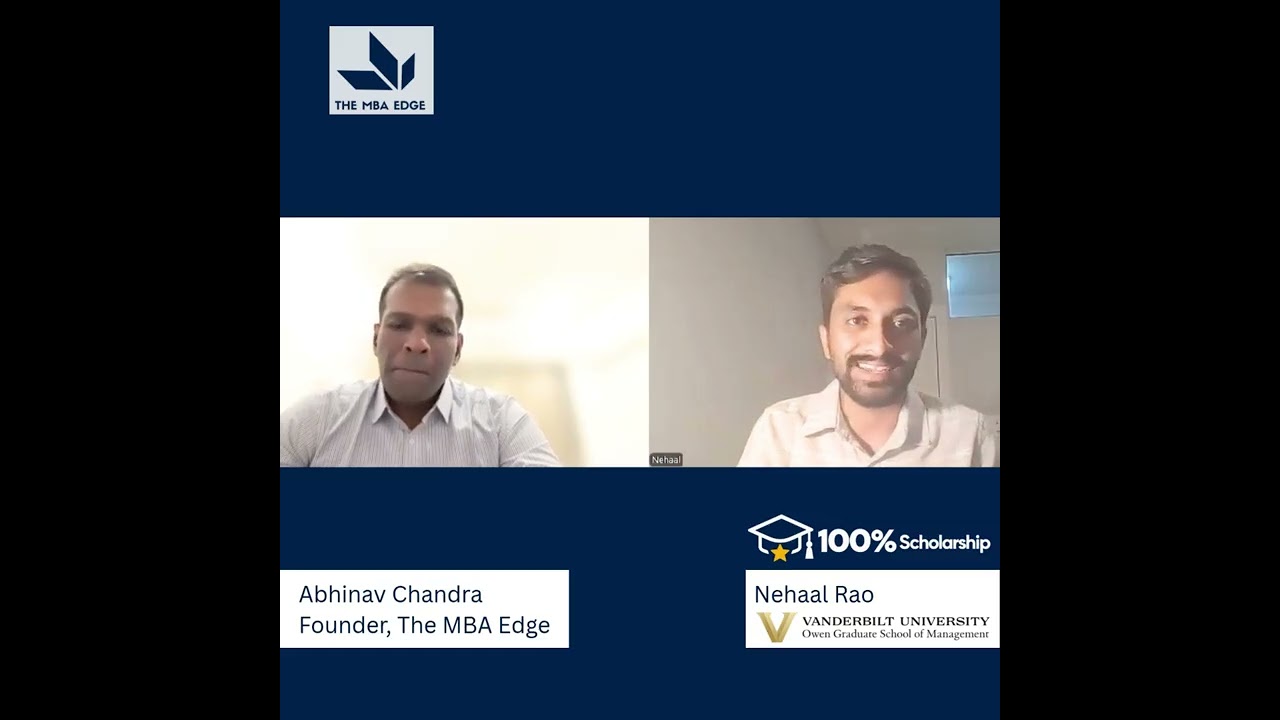
Scholarship – 100%
Undergraduate Institution
Christ College
Pre-MBA Career
Sustainability Marketing

From Marketing to Business Leadership: Nehaal’s Journey to Vanderbilt with a Full Merit Scholarship
After more than six years across FMCG, consumer technology and clean tech, Nehaal had built a strong career in marketing. He had worked across brand management, product marketing, partnerships and PR, and had gradually taken on more responsibility across different industries.
But there was a gap he increasingly wanted to address.
While he understood marketing deeply, he wanted to move beyond being a functional specialist and develop a broader understanding of how businesses work as a whole. He wanted to eventually make decisions across functions, lead larger transformations and build a more global perspective.
That led him to pursue a Global MBA.
After a challenging application journey that included multiple rounds, unexpected outcomes and several admits, Nehaal ultimately chose Vanderbilt University's Owen Graduate School of Management, where he will pursue his two-year MBA with a full merit scholarship.
We spoke to Nehaal about his career journey, what prompted him to pursue an MBA after six years of work experience, navigating the US MBA application process, choosing Vanderbilt, and what he would tell someone starting their own MBA journey today.
Nehaal, you have a pretty unique background. You've worked across FMCG, consumer technology and clean tech, and you're now heading to Vanderbilt with a full merit scholarship. Tell us a little about your journey so far.
Nehaal: Thanks, I'm originally from Hyderabad, and I completed my Bachelor's in Business Administration from Christ University in Bangalore, where I specialized in Marketing.
I decided quite early that marketing was the path I wanted to pursue. One of the things that influenced me was that I was always more interested in the advertising around sports than the sport itself!
Over the last six to six-and-a-half years, I've worked across FMCG, consumer technology and B2B clean tech companies. I've had the opportunity to work across different areas of marketing, including brand management, product marketing, brand partnerships and PR.
So, professionally, I've always been a marketing and brand person. But over time, I started thinking about how I could move beyond being a functional leader and eventually become a broader business leader.
Why an MBA After Six Years of Work Experience?
Given your background, the conventional route would have been to continue building your marketing career and take on larger leadership responsibilities. What made you decide to step away from your career and pursue an MBA?
Nehaal: An MBA was always somewhere in the back of my mind.
Like many students in India, I thought about doing an MBA during my undergraduate years, but I deliberately chose not to take the traditional CAT-to-IIM route. I knew I wanted to work first because I felt the experience would make the MBA much more meaningful later.
Over the years, I moved from one role to another, took on more responsibility and worked across different sectors. My last role was at Recykal, where I got exposure to sustainability and the circular economy alongside my marketing responsibilities.
The more I worked, the more I realized that I was developing very strong functional expertise in marketing. At the same time, I was working closely with people in strategy, operations and other functions, and I became increasingly curious about what they brought to the table.
That's when I started thinking about the transition from being a functional leader to a business leader—someone who understands how different parts of a business work together and can make decisions at a much broader level.
That was the real motivation behind the MBA.
And because I had already built several years of work experience, I wanted to pursue a Global MBA. I wanted to be in an environment where my experience would be valuable, but where I could also learn from people with very different backgrounds and perspectives.
The Project That Changed My Perspective
Was there a particular moment or experience that made you realize you wanted to pursue an MBA?
Nehaal: There wasn't one single moment. It was really a combination of experiences.
But one project that stands out was a product I worked on as a Product Marketing Lead called the Digital Deposit Reference System. It was piloted by Recykal in India, and I was involved from the growth stage through its expansion across the Himalayan region, with discussions around further state-level expansion.
Working on that project made me realize the kind of impact that can happen when different stakeholders come together—including government departments, businesses and other organizations.
It made me think about the idea of business with a purpose.
Businesses obviously need to create value and generate profits, but they can also create meaningful environmental and social impact.
That experience made me think about larger-scale and more global opportunities. I realized that if I wanted to operate at that level, I needed a broader understanding of business beyond my own function.
That really pushed me towards pursuing an MBA.
Planning the MBA Journey
How did you approach the MBA application journey, from shortlisting schools to finally making your decision?
Nehaal: The first stage was really about discovery.
I started by looking at different countries and universities and trying to understand what made sense for my career goals.
The US was always on my radar because of the way the MBA ecosystem is structured there and the opportunities that follow from it. At the same time, I was also considering Europe.
When I started shortlisting universities, I focused heavily on what I wanted to do after the MBA.
Given my background, product marketing was a natural path. I was also interested in exploring consulting.
So I looked for universities that were strong in both areas, while also being realistic about the incoming class profile, test scores and the overall fit.
Finding Your Story
Nehaal: One of the biggest parts of the process was actually spending time understanding my own story.
Before writing the essays, I spent a lot of nights going through my experiences—both professional and personal—and writing down the stories that had shaped me.
Then, when I looked at each university's essay questions, the challenge was to identify which of those experiences genuinely answered the question.
The best essays, in my view, come from a combination of three things: your own experiences and self-discovery, the direction you want to take your career, and what the particular university values and offers.
It's about finding the intersection between your story and what the school is looking for.
The Application Process: Expect Surprises
How did the application process eventually play out? Were there any surprises?
Nehaal: Absolutely.
Round one didn't go exactly as I had expected. The number of applications I submitted and the number of interview invitations I received didn't really match what I had anticipated.
And that's probably one of the most difficult things about the MBA application process—you don't always know why a particular university says yes or no.
I received interview invitations from some very highly ranked schools, while some of the schools I thought would be safer options didn't invite me to interview.
That taught me that there isn't really a simple formula.
You can look at rankings, test scores and profiles, but ultimately you don't know exactly how a school will view your particular story in a particular year.
There is definitely an element of uncertainty—and probably a little bit of luck—involved.
After round one, I went back and reassessed everything. I spent my winter break rethinking my career goals, my approach and the schools I was targeting.
For round two, I deliberately created a much broader portfolio of schools based not just on rankings, but also on career goals and overall fit.
That worked much better. I eventually received three admits in round two.
Choosing Vanderbilt
Once you had multiple options, how did you decide where you wanted to go?
Nehaal: At that point, the decision became much more about fit.
I spent a lot of time speaking with alumni and understanding the student experience—things like the workload, internship and employment opportunities, the city and even the cost of living.
There are so many factors beyond rankings that become important once you actually have admits in hand.
After a lot of conversations and comparisons, I ultimately chose Vanderbilt University's Owen Graduate School of Management.
I'll be joining the two-year full-time MBA program in Nashville.
And I'm also incredibly grateful to have received a full merit scholarship, which covers my tuition.
That takes away a significant financial consideration and allows me to focus completely on making the most of the MBA experience, contributing to the community and figuring out what I want to do next.
Preparing for MBA Interviews
You interviewed with several universities. What was that experience like?
Nehaal: I interviewed with around seven or eight universities across both rounds.
Interestingly, I'd say about 70% of the interviews were fairly similar.
Most of the questions were behavioral. Almost every school will ask you to introduce yourself, so having a clear one-and-a-half to two-minute introduction is essential.
Then you get questions around your experiences.
Tell me about a time you were successful on a project.
Tell me about a time you failed.
Tell me about a difficult piece of feedback you received.
Tell me about something you learned from an experience.
The interviewer isn't just looking for the answer. They're trying to understand your personality, your values and whether you fit with the school.
Some interviews feel extremely professional, while others can feel almost like a casual conversation.
The key is finding the right balance—you shouldn't become too comfortable, but you also shouldn't sound overly rehearsed.
The more interviews I did, the more comfortable I became.
That's why I think mock interviews are incredibly important. Whether you do them with a consultant, friends, peers or anyone else, you need to get comfortable telling your story and responding to questions in real time.
What Does the Next Chapter Look Like?
So, after this entire journey, where are you heading?
Nehaal: I'm heading to Vanderbilt University's Owen Graduate School of Management for my MBA.
The full merit scholarship is obviously a huge privilege, and I'm extremely grateful for it.
I'll be moving to Nashville, which I'm also really excited about. It's a beautiful city, and the climate is quite comfortable for me.
Moving alone to a new country and starting life in a completely new environment is definitely going to be a big transition.
But at the same time, it's exciting.
I'm looking forward to taking risks, stepping outside my comfort zone and seeing where this next chapter takes me.
Advice for Future MBA Applicants
If you were in the same position you were a year ago, what advice would you give someone considering a Global MBA?
Nehaal: The first thing I'd say is that you need to be very clear about what you're looking for.
For me, getting into a strong university and program was always the priority.
The reputation of the program matters because you're not just paying for a degree. You're getting access to a network, classmates, professors and a broader ecosystem.
At the same time, you need to look at the realities of the current environment.
Whether you're considering the US, Europe or another destination, international education comes with uncertainties around visas, employment and the broader economic environment.
So have a Plan A and a Plan B.
That's not about being less confident. It's about being realistic and giving yourself options.
The wider you cast your net, the more choices you have when it comes time to make the final decision.
An MBA Is a Hard Pause, Not a Small Break
Nehaal: There's another thing I think applicants should really understand before starting this journey.
An MBA isn't just a small break from your career. It's a significant pause.
Whatever you've built before business school—whether you're in marketing, consulting, private equity, an MNC or a startup—you need to think carefully about what you want to do next.
And don't assume that your background automatically determines your chances.
Someone from a large company, someone from a startup and someone from a completely different background can all have compelling MBA applications.
What matters is how you frame your journey.
Understand your own story, understand why you want the program, and show that you genuinely have the motivation to learn and contribute.
And most importantly, don't hesitate to take the risk.
Looking Back
Nehaal, it's been great speaking with you. Congratulations once again, and we wish you all the very best at Vanderbilt and beyond.
Nehaal: Thank you so much. And thank you for all the help throughout the process.
To anyone watching who's considering an MBA, all the very best. And if you ever want to reach out, I'm always happy to share my experience.
If you are planning to apply to MBA programs this upcoming application season, reach out to our team at info@thembaedge.com to explore synergies to collaborate together.
Follow The MBA Edge where we regularly post information on MBA applications and careers.